Hats Off To You!

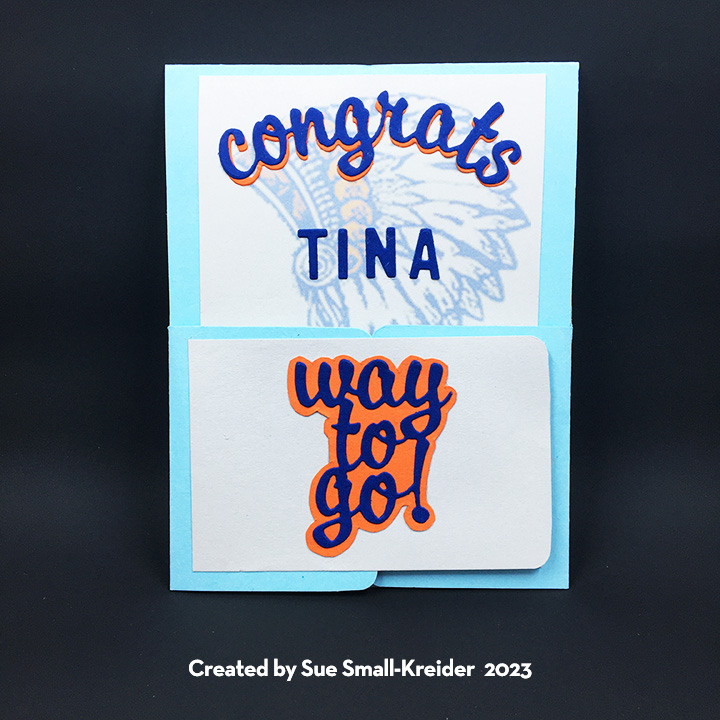
It’s graduation season and the Craft Roulette Episode 161 gave me the idea for this commissioned card for a high school graduate with the Dutch door cardbase, hats, campfire colors and book page element.

All of the dies used are by Karen Burniston. They include the Heart Collage Pop-Up (for the mechanism), Book Worm and Tiny Accessories 2 (both for graduation caps.) The hands and printed sentiments come from a Simon Says Stamp set called Hats off Grad.

Cardbase: Using a T-ruler and pencil, mark the measurements shown on the photo below on an 8 1/2″ x 11” sheet of heavyweight light blue cardstock. Trim off excess rectangles and then score and fold with metal ruler, scoring tool and Teflon folder. Erase pencil marks. Using a small corner punch, round all six corners.

Hat Mechanism: Watch the assembly videos on the Heart Collage Pop-Up page before die-cutting the mechanism piece from light blue cardstock matching the cardbase. Adhere to top fold as directed in assembly videos. Using a stencil and white ink, stencil clouds over the top inside of card, going over the mechanism. Cut out and assemble a number of graduation caps from Book Worm set (small caps) and from the Tiny Accessories 2 (large caps.)

Money Holder: Take a 3” x 4” piece of white copier paper and score along the short side 1/2″ from the edge.  Score both long sides at 1/4″, 1/2″ and 3/4″. Accordion-style fold the long sides and then fold short side under to form a gusseted pocket. Using a small circle punch, cut a half circle at top of pocket as a finger hold.

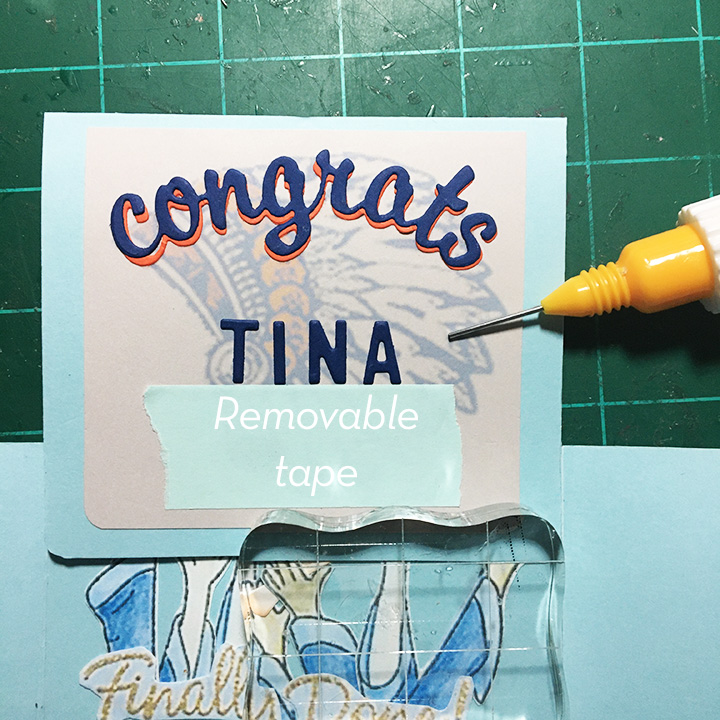
Sentiments: The large die-cut sentiments all come from the same Karen Burniston Word Set 8. “Congrats” was cut once from navy blue and once from orange – the high school’s colors. The two phrases were cut from navy blue and then their dies were traced on the outside on orange cardstock and fussy cut to create shadows for the words. The graduate’s name was die-cut using Karen Burniston’s Mini Alphabet set and lined up on card using removable paper tape.

Decorations: The high school logo was printed from the school website on light gray and white cardstock for the front and back of the card. (Because I could not find my Hats Off Grad stamp set, I had to print an image from photos of another card I had made using the stamp set.) The “Finally Done! Hats Off to You!” sentiment was fussy cut along with the hands which were glued to the sentiment before being glued to the card base.  Five hearts and two diplomas were added to the hat mechanism and background die cut from the Tiny Accessories 2 set. The math book on the money holder was die cut from the Book Worm set. The labels for a personal message are from two coordinating sets – Label Charm Pop-Up and Crosshatch Rectangles and Labels.

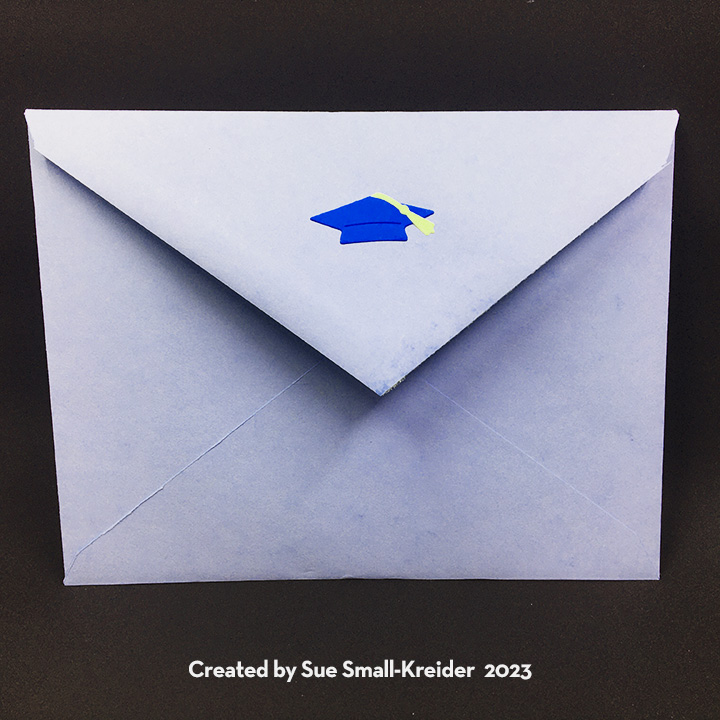
Envelope: The card fits into an A2 envelope. I like to hint at what’s inside the envelope, so a small graduation cap was glued to the back envelope flap.

Thank you for reading this blog post. I hope this inspires you and makes you smile. Please like and leave comments 😊

Materials Used:

Dies

Stamps & Stencils

  • Simon Says Stamp! -Clear Stamp and Matching Dies-Hats off Grad -sss102120
  • Favorite Things – Clear Stamps – Free-010 Hand Stamped
  • Craftin Desert Divas – 6×6 Stencil – Clouds and Paths

Papers

  • Navy Blue, Orange, White and Gray Cardstock
  • White Copier Paper
  • A2 Light Blue Envelope

Ink

  • Ranger – Tim Holtz – Distress Oxide- Tea Dye
  • Memento – Fad-resistant Dye Ink – Tuxedo Black
  • Simon Says Stamp – Premium Pigment Ink – White
  • Sakura – Gelly Roll Pen – Medium – Black
  • Computer Printer

Adhesives

Tools

  • We R Memories – QuickStick
  • Die Cutting Machine
  • Stamping Platform
  • LDRS – Stampendable Stamping Tool
  • Stamping Cloth
  • Sponge Dauber
  • Heat Tool
  • Craft Mat
  • Scissors
  • Metal Ruler
  • Scoring Tool
  • Scoring Board
  • Teflon Pencil Tipped Folder
  • Clear T-Ruler
  • ¾” Circle Punch
  • Small Corner Punch
  • Removable Paper Tape
  • Pencil
  • Sand Eraser

Miscellaneous

  • Fun Stampers Journey – Twine – Teal Blue

Just Because You’re Sweet!

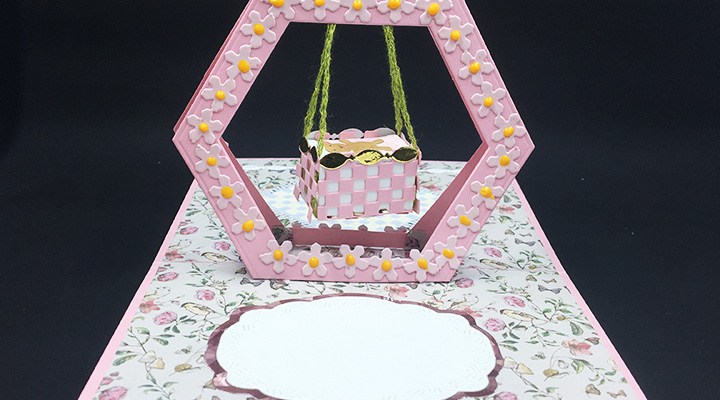
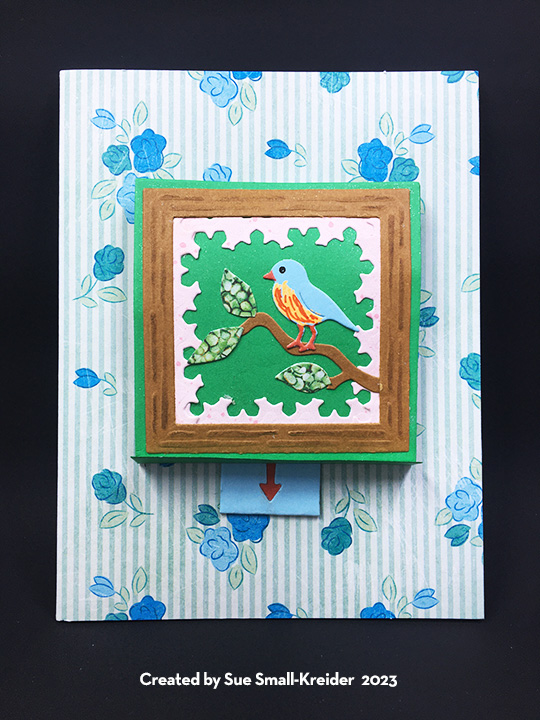
This card was made for Craft Roulette #162 whose parameters included a matchbook card, flowering field colors, a bird and woodgrain.

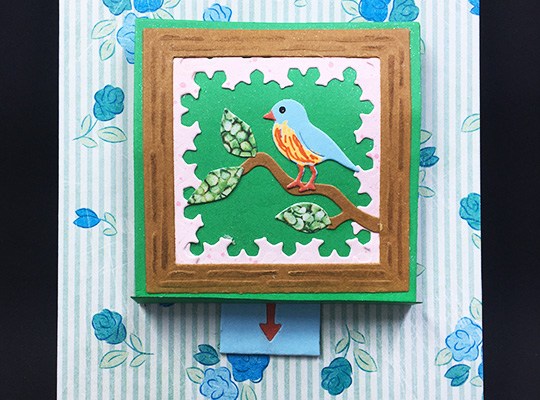
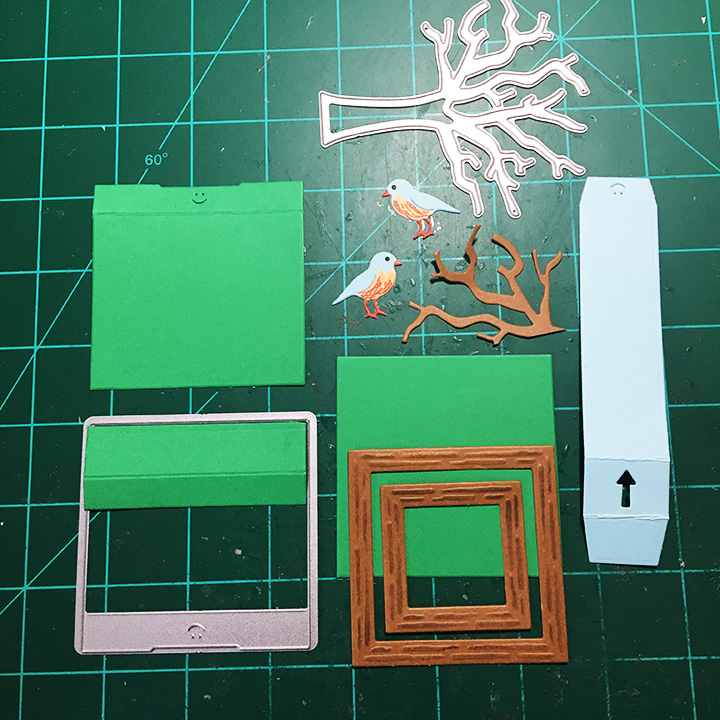
For the pop-up card on the purchased printed cardbase, I used Karen Burniston’s Frame Pull Pop-Up die set and branches and leaves from her Tree Pop-Up die set.

I followed the basic assembly video instructions for the Frame pull Pop-up using the packaging image as my design inspiration. Before I attached the mechanism to the card, I glued an inch long strip to the bottom and folded it over to form the lip of the matchbook.

Because the green background seemed bland, I covered it with a glitter gloss for some sparkle.

The blue birds were colored with markers while the tree leaves were cut from spotted green paper. I used some pink border scraps for the pink inside the woodgrain frames. The frames were embossed then die-cut and finally inked with a darker brown ink using the stenciling feature on the dies.

The sentiment comes from two of Karen Burniston’s die sets – Word Set 15- Just Because and You’re Sweet!

For the envelope’s back flap, I used a flower from a Bright Rosa stamp set stamped with pink ink.

Thank you for reading this blog post. I hope this inspires you and makes you smile. Please like and leave comments 😊

Materials Used:

Dies

Stamps

  • Bright Rosa by Paula Pascual – Fern Die and Stamps – from Simply Cards & Papercrafts Magazine issue 202

Papers

  • Lawn Fawn – 6×6 Double-Sided Paper Pad – Spiffy Speckles
  • Green, Blue and Brown Cardstock
  • Green Spotted Scrap
  • Printed A2 Cardbase and Envelope

Ink

  • Ranger – Tim Holtz – Distress Ink- Walnut Stain
  • Simon Says Stamp – Pawsitively Saturated Ink – Sweets
  • Sharpie – Ultra Fine Tipped Marker- Racey Red and Orange
  • Staples – Liquid Stix – Neon Orange Chisel Nose Highlighter
  • Nuvo – Aqua Shimmer Bruch Pen – Glitter Gloss

Adhesives

Tools

  • Die Cutting Machine
  • We R Memories – QuickStick
  • We R Memories – Scoring Board and Trimmer
  • Stamping Platform
  • LDRS – Stampendable Stamping Tool
  • Stamping Cloth
  • Sponge Dauber
  • Craft Mat
  • Scissors
  • Ruler

Vintage Christmas Cards – Room Scene

Recently I came across some family Christmas cards I had designed with the help of my father who owned a letterpress printing press and had cuts (think metal stamps on wooden blocks similar to rubber stamps on wood blocks) made of my drawings. The printing press held an 8×10-inch frame which held the cuts and metal type (letters). Paper was hand-fed into the press which had an electric motor connected with a leather belt which turned the press wheel. From about age 8 and on I earned pocket money running the press to add people’s names to their store-bought Christmas cards, “From the Desk of” notepads and other small print jobs from family and friends.

The five cards that I am sharing this week were created before the computer drawing program Auto-CAD was widely available to individuals. (I know we didn’t have access to digital type fonts that Apple computers offered around that time.) I used rulers, India ink pens and protractors to draw the pop-ups.

In 1985 I designed a pop-up room scene featuring a fireplace tabletop Christmas tree and a cat. I used rub-ons that were popular at the time to created graphics. All the straight lines were rub-ons as well as the letters on the garlands. I used a plastic drawing template for the circles and arcs. The cat was a sticker that had been reduced on a photocopier.

These postcards were hand-colored with watercolors and markers.

On the back of the postcard was the first of my CRX drawings that showed how the finished pop-up should look along with cutting and folding instructions.

I believe this was the last of the family designed Christmas cards as my father discovered Graphics3, a family-owned printing business in Jupiter, Florida that made 3D pop-up cards and began ordering from cards from them.

Here are other vintage Christmas cards:

  • Room Scene

Vintage Christmas Cards – Sleigh

Recently I came across some family Christmas cards I had designed with the help of my father who owned a letterpress printing press and had cuts (think metal stamps on wooden blocks similar to rubber stamps on wood blocks) made of my drawings. The printing press held an 8×10-inch frame which held the cuts and metal type (letters). Paper was hand-fed into the press which had an electric motor connected with a leather belt which turned the press wheel. From about age 8 and on I earned pocket money running the press to add people’s names to their store-bought Christmas cards, “From the Desk of” notepads and other small print jobs from family and friends.

The five cards that I am sharing this week were created before the computer drawing program Auto-CAD was widely available to individuals. (I know we didn’t have access to digital type fonts that Apple computers offered around that time.) I used rulers, India ink pens and protractors to draw the pop-ups.

My siblings and I think the sleigh postcard was created around 1984 using an image found in a Dover Publications clip art book. (We didn’t document our source as it was an image in the public domain.)

The sleigh was manipulated on a photocopying machine. The image was cut-out twice and one image flipped on its back side and traced with an ink pen. A ruler and protractor were used to create the rectangular shapes and tabs that connected the sides. Rub-on lines were used to create the various thickness of lines and perfect corners.

The instructions, title and tab letters were printed using hand-set type and the cut and pasted onto the drawing. (You can see one of the “F” tabs shows the overlap of paper covering the line.)

These postcards were hand-colored using red makers. We printed 400+ of these cards starting in October.

A few of our friends said they had cut and assembled the sleigh.

Here are other vintage Christmas cards:

  • Sleigh

Vintage Christmas Cards – Fireplace

Recently I came across some family Christmas cards I had designed with the help of my father who owned a letterpress printing press and had cuts (think metal stamps on wooden blocks similar to rubber stamps on wood blocks) made of my drawings. The printing press held an 8×10-inch frame which held the cuts and metal type (letters). Paper was hand-fed into the press which had an electric motor connected with a leather belt which turned the press wheel. From about age 8 and on I earned pocket money running the press to add people’s names to their store-bought Christmas cards, “From the Desk of” notepads and other small print jobs from family and friends.

The five cards that I am sharing this week were created before the computer drawing program Auto-CAD was widely available to individuals. (I know we didn’t have access to digital type fonts that Apple computers offered around that time.) I used rulers, India ink pens and protractors to draw the pop-ups.

For the 1983 stand alone fireplace, I know I was influenced by the cardboard fake fireplaces that were popular Christmas decorations in my childhood. The mantel design may have come from family homes or other 1920’s bungalow style homes with brick fireplaces. It is a more complex assembly with many smaller pieces. I remember printing the instructions and tab names with hand-set type and then cutting and pasting them onto the drawing, before sending it all off to be made into a metal cut.

My father had a little more experience with creating the colors using rub-on sheets of dots to create the coloring of sections of the drawing. Using a photocopying machine, he reduced the size of the dots to make them more intense and he did a reverse of the dots and space in between for the fire. Then he had three cuts made – one for the black drawing, one for the green stockings and mantel greenery and the last one for the red bricks and fire.

For one postcard, it took four runs through the printing press. We printed 400+ of these cards starting in October.

A few of our friends said they had cut and assembled the tiny fireplace adding the suggest string loop to make it a Christmas ornament.

Here are other vintage Christmas cards:

  • Fireplace

Vintage Christmas Cards – House Box

Recently I came across some family Christmas cards I had designed with the help of my father who owned a letterpress printing press and had cuts (think metal stamps on wooden blocks similar to rubber stamps on wood blocks) made of my drawings. The printing press held an 8×10-inch frame which held the cuts and metal type (letters). Paper was hand-fed into the press which had an electric motor connected with a leather belt which turned the press wheel. From about age 8 and on I earned pocket money running the press to add people’s names to their store-bought Christmas cards, “From the Desk of” notepads and other small print jobs from family and friends.

The five cards that I am sharing this week were created before the computer drawing program Auto-CAD was widely available to individuals. (I know we didn’t have access to digital type fonts that Apple computers offered around that time.) I used rulers, India ink pens and protractors to draw the pop-ups.

The 1982 “From Our House To Your House” house box postcard was an outgrowth of my fascination with creating house boxes. I had been introduced to box making in a high school commercial art class where I created a blue and white farmhouse box for perfume. At college I expanded on the farmhouse box design by creating a cardboard embossing plate to add raised clapboard siding and roof shingles that was run through an intaglio press. In 1981 I had completed an internship at a historic house museum which was a red brick Victorian house.

The challenge with creating a house box on a postcard was how much would fit on a 5 3/4-inch x 3 3/4-inch postcard. I drew the box on an 8 1/2-inch x 11-inch sheet of paper and used a photocopying machine to reduce it in size.

My father was experimenting with a new technique for him using rub-on sheets of dots to create the coloring of sections of the drawing. He had three cuts made – one for the black drawing, one for the green roof, door wreath and greenery and the last one for the red bricks.

For one postcard, it took four runs through the printing press. We printed 400+ of these cards starting in October.

A few of our friends said they had cut and assembled the wee house box adding the suggest string loop.

Here are other vintage Christmas cards:

  • House Box

Vintage Christmas Cards – NO L Tree

Recently I came across some family Christmas cards I had designed with the help of my father who owned a letterpress printing press and had cuts (think metal stamps on wooden blocks similar to rubber stamps on wood blocks) made of my drawings. The printing press held an 8×10-inch galley or frame which held the cuts and metal type (letters). Paper was hand-fed into the press which had an electric motor connected with a leather belt which turned the press wheel. From about age 8 and on I earned pocket money running the press to add people’s names to their store-bought Christmas cards, “From the Desk of” notepads and other small print jobs from family and friends.

The five cards that I am sharing this week were created before the computer drawing program Auto-CAD was widely available to individuals. (I know we didn’t have access to digital type fonts that Apple computers offered around that time.) I used rulers, India ink pens and protractors to draw the pop-ups.

The NO L Tree card was a mash-up of another Christmas card my parents had done in the 1950s spelling out the alphabet but leaving a space where the “L” would have been, and a 3D triangle tree that I had made as a child which was made of two triangles cut with slits that allowed them to slide together. My father suggested having the sentiment in red ink be on two quadrants while the green alphabet be on the remaining two quadrants. We decided on different type fonts for the two sides.

Hand setting the type was a little challenging, but after several test runs, we found the proper placement. I think we created a cardboard template to trace the tree lines inside the card with a black pen.

Instructions on how to assemble the tree as well as the card title/subtitle and card credits were all made with hand-set type. To print one card, it took two runs of green ink, two runs of red ink and one run of black ink for a total of five runs and one hand tracing of the triangle lines. We would print 200+ cards each year and start printing in October.

My siblings and I think this card was made around 1980-1981.

Here are other vintage Christmas cards:

  • NO L Tree

Mother’s Day Keepsake Card

Recently I received a commission to make a Mother’s Day card that was to have all four of her children’s birthdays and names on it. The recipient likes gardening, traditionally receives flowers on Mother’s Day to plant in her garden and may soon be moving to a new home.

I began by looking through my paper stash and settled on a Graphic 45 paper collection that featured flowers of the months.  Karen Burniston’s Waterfall Card dies made it easy to create four different waterfall panels. It was the backgrounds panels for the card that were a bit more difficult since I had already cut into the papers for other projects. I ended up piecing together stripes of the flowers from the various months needed for the front of the card and a patchwork for the inside top panel. For the inside bottom panel that the waterfall rests on, I made stripes of the ribbon from the various flower papers. The card back is a whole piece of flowered cardstock.

Having reviewed the waterfall assembly video, I knew that a 5×7 (A7 size) card base with a top fold could accommodate the waterfall. For the hidden message of “love you,” I used the words from Karen Burniston’s Words Set 13 to die-cut into the decorative panel that goes to the pull strip. The background papers had all been adhered to the purchased card base when I die cut the finger semi-circle into the card base bottom panel. Having assembled the waterfall mechanism, I then stapled it onto the card base as shown in the assembly video.

For the customization of the names and birthdays, I used the postage stamp ephemera pieces from the paper collection for the month and then added the names and dates using Karen Burniston’s Mini Alphabet and Numbers die set.

Card Back

Ribbon can hide a multiple of small mistakes and liven up a card. On this card it softens the staples on the back of the card and brightens up the card front. The front sentiment is Karen Burniston’s “Happy Mother’s Day” which includes a shadow background die in the set. The white label inside can be used for a personal message and is cut using the largest of the fancy labels in the Crosshatch Rectangles and Labels die set.

The envelope uses more of the flowered paper for the back flap.

Materials Used:

Dies

Papers

  • Graphic 45 – 12×12 Double-Sided Paper – Flower Market Collection
  • DCWV – Textured Cardstock Stack 12×12 – Brights
  • Black Cardstock
  • Park Lane Paperie – A7 Card Base and Envelope – White

Pens

  • Pigma Micronn – Archival Ink – 01 Tip – Black
  • Sharpie – Permanent Marker -Ultra Fine Point – Black

Adhesives

Tools

Miscellaneous

  • Yellow Organza 3/4-Inch Wide Ribbon

Mother’s Day Flower Cart

It’s time for the Karen Burniston design team challenge for May 2023 with the theme of BEJEWELED.

My inspiration for this card was drawn from a similar cart made by a crafting friend Diana Bentham several years ago and a video by Anna Griffin.

Cart Drawer: The cart is based around the Slider Box. Watch the assembly video before die-cutting pieces. I used blue 100 lb. cardstock for the box and 65 lb. white cardstock for the drawer. A piece of sheer blue ribbon was used as a drawer pull. A Bam Box (see assembly video) is what pops up the message of “Thank you love you.” The sentiment is from Word Set 13 – Snow and Word Set 1 – Greetings while the rectangle is cut using one of the slider box decorative dies. Another decorative die with crosshatches was used to line the drawer with a polka dotted pink paper. The front of the drawer is decorated with the scrap from cutting the scalloped roof.

Cart Base: The cart’s frame made by die-cutting two of the Fancy Label Accordion panels and removing the center pivot panel to create a square frame with a tab on one side. Fold in half with tab side facing up. Glue the u-shape together. I took the two smallest of the off-cuts from the die cut to make the cart handles. (Glue the pieces back-to-back for stability.) Glue handles on to slider box at open end before adhering the u-shape frame to slider box.

Flowers and Pails: The flowers were cut from two shades of pink greeting card envelopes that I upcycled. The dies used come from three different sets – Flutter Charms, Flowers and Bee, and Flower Pot Pop-Up. (The flowers in Flowers and Bee and the Flower Pot Pop-Up are the same.) I used yellow posy flatback gems as the larger flower centers and sparkly resin gems for the smaller flowers. You can create some dimension to the flowers by shaping them with your fingers. I glued flowers on to scrap pieces of green cardstock that were glued into the silver pails.

The pails are cut from another upcycled envelope of holographic silver using the pail from the Adirondak Chair Pop-Up. I cut a front and a back for each pail, plus four more single-sided pails, cutting 16 pails total. Flowers are glued on both front and back of the six pails that line the cart’s sides. Four pails are glued to a small cube I made from matte silver cardstock and adhered to the center of the cart’s tabletop.

Roof Frame: The striped roof awning is cut from some digital striped paper using the large scalloped edged rectangle in the Rectangles and Labels – Crosshatch set. It is held up by a frame made by die-cutting two of the Fancy Label Accordion in white cardstock and cutting off the center pivot panel and side tab. (My cardstock was lightweight, so I cut a third frame and cut it in half to back the lower portion of my frames.)

Fold each of the frames at 2 3/4-inches. Glue the frames on to the sides of the cart base, lining up the bottom edge of the white frame to the inside edge of the blue cart frame.

Cut three strips of white cardstock 1 1/2-inches long by 1/2-inch wide. Fold each strip in half. Pinch the top halves of the roof frames towards each other to form triangular frame. Glue together with the three strips. Scraps from the die-cutting of the scalloped roof were used to decorate the cart sides.

Roof Sign: For the roof sign the “Happy Mother’s Day” was die cut twice using a deep blue foiled cardstock glued to two of the crosshatch fancy label from the Rectangles and Labels – Crosshatch set. A strip of white cardstock 5-inches long by 1/2-inch wide was folded in half and then the folded end was sandwiched between the two fancy labels and the labels adhered together. (You now have the equivalent of a large paper brad with two legs.) A slit was cut in the roof fold center for the legs of the sign to slide through and be glued to the underside of the roof.

Message Label:  A personal message can be written on the front of the cart’s label made from the smallest of the fancy labels in the Rectangles and Labels – Crosshatch set and the green mat from the dotted label from the Label Charm Pop-Up set.

Wheels: For the wheels I made a template using middle plain and crosshatched circles from the Circles – Crosshatch set. Cut the plain circle from scrap paper and the place the crosshatch circle die in the middle of the paper circle. Trace around the center of crosshatch die. Fold the paper in half, then half again and once more in half to come up with eight sections of the circle. Using a see-through ruler, mark and draw 5mm wide spokes interesting in the middle of the circle.

Die-cut from brown mirror or foil cardstock two plain circles. On the back side of the circles use the paper template to trace the triangles that need to be cute out using a craft knife and straight edge. Color the back of the wheels with black marker.

Die cut two black circles using the larger of the circles from either the Flowers and Bee or the Flower Pot Pop-Up set. These will be the wheel hubs. Top hubs with Nuvo Drops and flat-backed pearls.(Allow Nuvo Drops to dry 24 hours before gluing onto cart.)

Glue wheels onto cart’s front posts. Trim off posts just below wheel hubs.

Finished Measurements: This is card/gift box is designed to hand delivered and measures 8-inches high, 6 1/2-inches wide and 3-inches deep.

Thank you for reading this blog post. I hope this inspires you and makes you smile. Please like and leave comments 😊

For more Slider Box creations click here.

Materials Used:

Dies

Papers

  • Spellbinders-Color Essentials Cardstock – 100 lb – Raindrop -CS-019
  • White, Black and Green Cardstock Scraps
  • Pink and Silver Holographic Recycled Envelopes
  • Brown and Deep Blue Mirror/Foil Cardstock
  • Matte Silver Cardstock
  • Ully Cat Designs – Digital 8.5×11 Cardstock – Blue Awning Stripes

Pens/Gels

  • Sharpie – Permanent Marker Chisel Tip – Black
  • Nuvo Jewel Drops – Coco Blush

Adhesives

Tools

  • Die Cutting Machine
  • Quickstik Tool
  • Scissors
  • Tweezers
  • Metal Ruler
  • Craft Knife
  • Pencil

Bling

  • Queen & Co. – Posies Topping – Golden
  • Craft Consortium – Designed by Hackney & Co. – Enamel Dots – Gardener Delight
  • Stampin’ Up – Wonderful Gems
  • Blue Sheer Ribbon 5/8-Inch Wide