Easter Card For A Child

This card was made for Craft Roulette #168 whose parameters included a kid’s card, citrus colors, a spring scene and something metallic or foil. Maymay was the guest crafter and talked about her young nephew who writes books and has a series about Evil Chicken. Her card included Evil Chicken and she showed how to make him from scraps of cardstock.

This card was made using all Karen Burniston dies.

Cardbase: For this gatefold A7 (5×7-inches) card I started with a piece of cardstock 10×5-inches and scored and folded 2.5-inches from each of the ends longwise. Next, spritz the ends of the card before using an embossing folder to make the card front more interesting.

Chicken: The chicken is made up of a large white triangle, a tiny yellow triangle, a small dash of black, half a tiny red flower, and a thin strip of black cut into two legs and four toes. I added a wing from a scrap of white. Grass was cut using a die from the Nature Edges set.

Rabbit: The Easter Bunny was made with white and pink scraps using the Spring Animals die set. A tiny basket and eggs are also part of the die set. I colored one of the eggs with a blue metallic marker. I made two baskets one is hung on the bunny’s arm and the other is on the envelope flap.

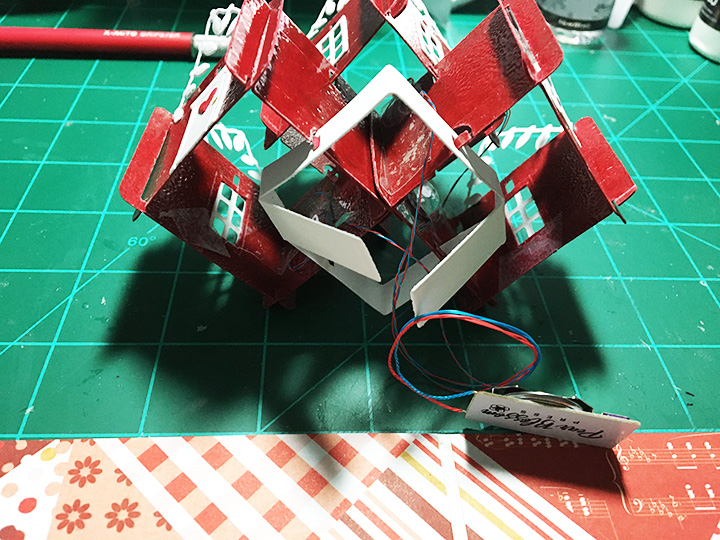
Eggs and Mechanism: I used some eggs I had made before using metallic ink with the stencil feature on the egg dies from the Easter Charms set as well as making some citrus colors (yellows and orange) eggs from solids and patterned paper scraps. For the two mechanisms that spin the eggs around when the card is opened, I used the Heart Collage Pop-up set. (Assembly video). The mechanism is glued into the card fold. I marked a spot 2-inches from the bottom of the left fold and 2-inches from the top of the right fold. Using the mark center a mechanism over the mark and line up the fold. Glue one tab to card and fold up the mechanism as instructed in the assembly video. Place glue on other tab and close card flap to glue in place to card. Repeat for other side.

Sentiments: I created the sentiments on Canva and then resized them in Publisher.  You can download a copy. After printing them, I roughly cut the main question onto white cardstock and fussy cut a cloud shape around the words. A Velcro dot was used on the back side of the cloud as a card closure. The answer sentiment was cut directly from the paper in a cloud shape and glued to the inside cardbase. The “Happy Easter” was cut out with a stitched rectangle die from the Slim Frames die set. A post was cut from a scrap of brown with left over grass from the front of the card.

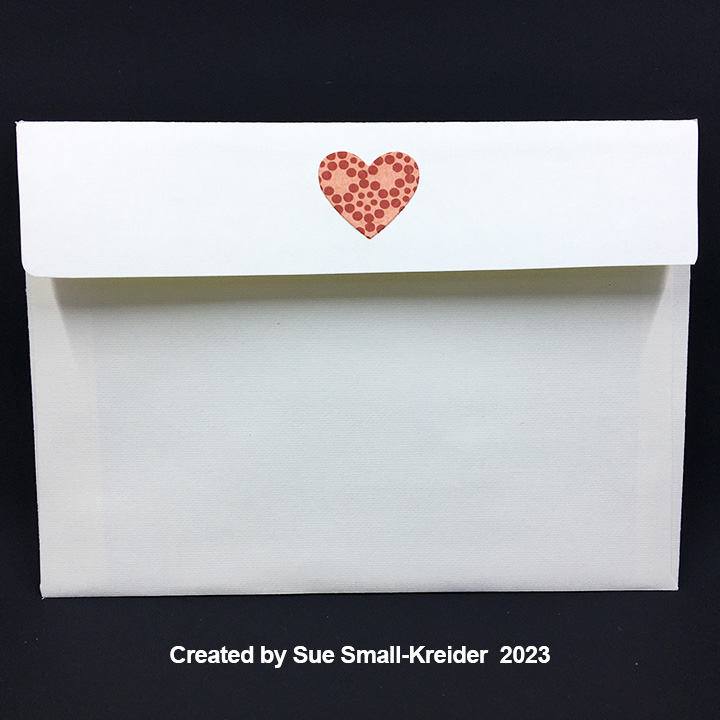
Envelope: The card fits into an A7 envelope. To give a hint as to what’s inside, a small Easter basket was glued to the back envelope flap.

Thank you for reading this blog post. I hope this inspires you and makes you smile. Please like and leave comments 😊

Materials Used:

Dies

Embossing Folder

  • Spellbinders – 3D Embossing Folder 5.5×8.5-inches – Dimensional Diamonds

Papers

  • White, Black, Red, Pink,  Brown, Green, Orange, Blue and Yellow Cardstock
  • Patterned Paper Scraps
  • A2 ivory Envelope

Ink

Adhesives

Tools

  • Die Cutting Machine
  • We R Memories – QuickStick
  • We R Memories – Scoring Board and Trimmer
  • Scissors
  • Stamping Blocks/ Weights
  • Ranger – Mister Bottle
  • Bone Folder

Miscellaneous

  • Velcro Closure

Mother’s Day Blossoms

It’s Sneak Peek Week for Karen Burniston’s June 2023 Release.

Mother’s Day is a special time to send photos of one’s children. What better way than to include their smiling faces in a garden themed card. This card features Karen Burniston’s new Twist Flower Pop-Up die set as well as two previously released sets – Happy Mother’s Day and the Long Rectangles – Crosshatch.

Cardbase: Cut a 7 1/4 inch x 8 1/2 inch rectangle of lime green cardstock. Fold in half longways to form a 8 1/2 inch tall by 3 5/8 inch wide side-fold card.

Flowers: Cut three sets of the large flower die in the Twist Flower Pop-Up set once in yellow, again in pink and lastly in reddish orange. (Total of nine flowers.) Cut four center circles from yellow and two center circles from dark green. Cut six of the tiniest flower die from dark green and three from yellow. (You may wish to cut enough pieces to assemble one more, large flower for the back of the card. I used some of my leftover pieces for the flower on the card back.) Glue the tiny flower to the circle and then the circle onto a large flower. Repeat until six flowers are assembled. Save the remaining three tiny flowers to decorate the envelope.

Print photos of faces that have been sized to fit inside a 1-inch square. (I used the software Publisher to make a 1-inch grid and then insert the photos to the correct size and printed onto an 8 1/2 x 11 inch sheet of printer paper.) Cover the printed faces entirely with clear packing tape. Cut faces out using the center circle die.  Glue faces to three different colors of the large die-cut flowers.

Twist Bases: Cut three of the twist mechanisms from lime green cardstock using die in Twist Flower Pop-Up set.  Train all the folds. Fold mechanism into the bunny face (middle of photo) and glue the small tab at the end of an ear onto the other ear. When unfolded it should look like a basket handle (left in photo.)

Using temporary tape attach the flowers to mechanisms. Layout the mechanisms making sure nothing goes outside the cardbase when folded closed. Glue one triangular side of the mechanism and then close card to glue the second triangle side. Add leaves to flowers using temporary tape to check for catch-points. Glue flowers and leaves in their final spots after decorating the rest of the card. (I found that flower petals can rub against the mechanism making the card creak as it is open and closed, so check for catch-points before gluing the flowers onto the mechanism. My finished card has several catch-points or creaky points as noted in red on the photo below.)

Decorations:  Die-cut a border for the card front using the two largest dies in the Long Rectangles – Crosshatch set. The leftover center rectangle can be used on the back of the card. (Because my remaining piece of the green dotted cardstock was not big enough to cut a whole new frame, I just cut four stripes using the dies still taped together for the frame.) These border stripes are used inside the card to cover the mechanism edges and create a trellis effect for the three large flowers used as decoration beside the pop-up flowers.  Along with the sentiment, three of the large flowers with leaves are used on the card front. Cut three hearts using the die in the Twist Flower Pop-Up set to place above a white personal message label. (I cut my label using the fourth largest die in the Long Rectangles – Crosshatch set and trimmed it to needed width.) From the Twist Flower set cut two of the daisy border from white cardstock. Add flower centers either by die-cutting tiny circles using the die that will cut 12 circles or use enamel drops. (I used Nuvo drops that I had to let dry overnight before gluing them in place.) The back of the card is decorated with leftover pieces.

Sentiment:  Using the shadow die from the Happy Mother’s Day set, cut one from shimmer cardstock. Cut the words from green cardstock. Glue together.

Envelope: Glue the three tiny flowers to the back of the envelope flap.

Thank you for reading this blog post. I hope this inspires you and makes you smile. Please like and leave comments 😊

Materials Used:

Dies

Papers

  • Catherine Pooler – 6×6 Single-Sided Paper Pad – Zen Plaid
  • Recollections – 8.5×11 White Gold Shimmer Cardstock
  • Green Heavyweight Cardstock
  • White Lightweight Cardstock
  • Lime Green Polka-Dotted Cardstock
  • #10 Business Envelope – Cream

Ink

Adhesives

Tools

Miscellaneous

  • Nuvo Crystal Drops – Dandelion Yellow
  • Clear Packing Tape

Rock-A-Bye Baby

It’s time for the Karen Burniston Design Team Challenge for June. We were asked to use the theme of wedding or baby. I have chosen to welcome a new baby.

To create this pop-up cradle swing, the following Karen Burniston’s dies were used: Bam Box Pop-Up, Crosshatch Hexagons, Picnic Elements, Christmas Trees Pop-Stand, a rubber band and some embroidery floss.

Cardbase and Pop-Stands: Cut an 11×4.25-inch piece of pink cardstock and fold to form a 5.5×4.25-inch top fold cardbase. (Watch Christmas tree pop-stand assembly video at the bottom of the die’s page.) Cut two pieces of decorative paper as 5.25×4-inches and use clear tape on the back side for placement in card. Use the hexagon for the cradle stand to determine placement of the pop-stand die-cuts. Using decorative paper scraps, cover the four holes that pop-stands leave on back side of paper.

Cradle Stand: taping the largest two plain hexagons from the crosshatch hexagon set, die cut two from heavy pink cardstock. Trim bottom edge .25-inch so that it will measure 4.25-inches or less to fit into cardbase.

Cradle: From the two leftover hexagons, die cut the checker grid from the blanket in the picnic elements set. (Watch assembly video at the bottom of the bam box page.) Create a white bam box and cut four pieces of the checker grid to be the sides of the bam box cradle. Cut two 6-inch pieces of green floss or cord. Glue floss/cord to bottom of bam box. Tape square pink end pieces to bottom of bam box with the floss glued to checker grid pieces. (I would recommend cord as the floss unraveled on me. Also I would glue the checker grid onto thin white copier paper to make less catch-points on the cradle.) Glue longer pink sides to bam box sides to form cradle. Use a border from the party border blends to create a finished edge of the cradle from gold foil cardstock. Glue the floss between the top bar of the two hexagons. Pull floss to make cradle hang straight before glue sets. Trim off excess floss once glue has dried. Cut one bam box decorator side piece from pink speckled paper and trim to fit the cradle as a blanket.

To make the cradle close, flatten bam box and fold in the square ends with floss. Hold flat as card is closed.

Blanket and Bears: Cut from pearlescent paper the fringed picnic blanket and from cream paper the checkered grid. glue together. Cut three teddy bears from light brown cardstock using bear die from the holiday charms set. Using the stencil features in the bear die, ink in eyes, nose and mouth with a black gel pen and the ears with a pink gel pen. One bear is in the cradle and other is on the blanket. The last bear is on the envelope flap.

Decorations: Flower borders cut from pink speckle paper using the long nature borders 2 set, are used on the cradle stand frame and card front and back. (Front with yellow Nuvo drops centers and back with pink gel pen stenciling.) More of the party border blends borders,cut from white cardstock, are used on all card panels. (See assembly video explaining how to get the border on the card back.)

Personal Message Label: The largest crosshatch label die from the rectangles and labels die set was cut in white.The thin metallic pink frame was made by using the largest label frame and the crosshatch label dies taped together. (This was a leftover piece I had saved from another project.)

Sentiment: Two sentiments were used to create the “Welcome BABY” on the card front. Welcome is its own die set with word (white) and shadow (pink speckle) dies. BABY is from the baby charms set which was cut once each from white and from pink and blue speckled papers. The blocks base is cut from white. Some paper piecing was done using pieces from the different papers to created the colorful blocks.

Envelope: The card fits an A2 size envelope.with the back flap decorated with a strip of the decorative paper and the last teddy bear.

Thank you for reading this blog post. I hope this inspires you and makes you smile. Please like and leave comments 😊

Materials Used:

Dies

Papers

  • Craft Consortium – Hackney & Co.- 6″x6″ Double-Sided 200gm Papers – English Garden
  • Lawn Fawn – 6″x6″ Double-Sided Paper Pad – Spiffy Speckles
  • Bazzill – 8.5″ x 11″ Heavy Cardstock – Cotton Candy
  • White, Cream and Cream Pearlescent Cardstock
  • Gold Foil and Pink Holographic Scraps
  • Staples – Invitation A2 Envelope – Pink

Ink

  • Gel Pen – Pink
  • Sakura – Gelly Roll Pen – Medium – Black

Adhesives

Tools

  • Die Cutting Machine
  • Paper Trimmer
  • Scissors
  • Craft Knife
  • Bone Folder
  • Kat Scrappiness – Telescopic Embossing Powder Tool with Retractable Brush
  • Quickstik Tool

Miscellaneous

Celebrating 66 Years of Marriage!

Recently I had the honor of creating a pop-up card celebrating a couple’s 66th wedding anniversary. Since there are no special designations for the 66th anniversary, I decided to go with silver, gold and sapphire blue as colors and balloons, stars, hearts and streamers as elements. My inspiration for the card came from a 50th anniversary card by Nicky Foden using Karen Burniston‘s Heart Collage Pop-Up, Balloon Collage Add-Ons and other dies.

Before I began, I read through Nicky’s blog on her card and watched Karen Burniston’s video on making a triple heart collage slimline pop-up card. I learned that I would need to trim down the outer mechanisms’ arms that will stick out of the card and continually test the placement of items to avoid catch points. The mechanism I used is the from the Heart Collage Pop-Up die set.

Cardbase: I used a medium weight white cardstock rectangle measuring 8 3/4 x 7 3/4-inches. When folded in half, the card measures 3 3/8 x 8 3/4-inches. Using the largest two dies from the Long Rectangles – Crosshatch die set, I cut frames from gold glitter cardstock and a large white rectangle to cover the front of the card. The frames went on the front and back of the card. For the inside of the card, I followed the dimensions of the largest die, but used a paper cutter to cut two panels of gold dotted acetate. (The acetate was too thick for the die to cut well.) While the glitter cardstock and white cardstock could be adhered using glue, the acetate required double sided-tape. Measuring the inside of the glitter frame on the back of the card, I cut a piece of acetate to fit the opening.

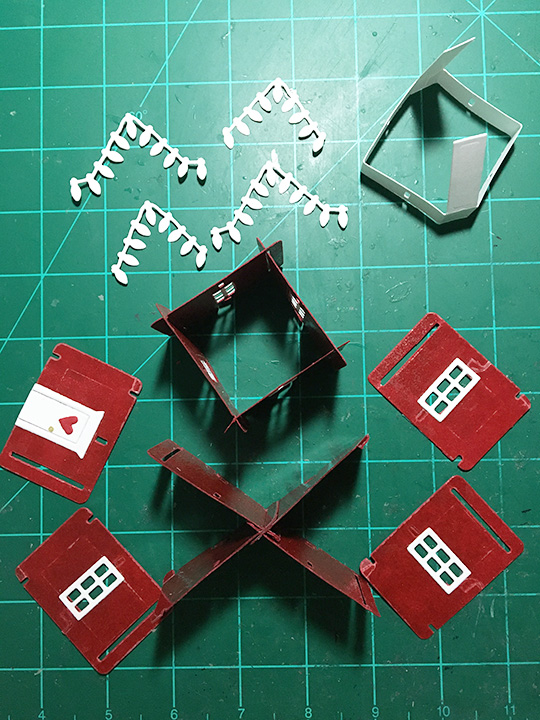
Mechanisms: Following Karen’s instructions on the placement of the mechanisms, I marked the locations with pencil on the inner fold. Making sure to line-up the pencil mark in the center hole of the mechanism and aligning the mechanism fold to the card fold, before I adhered one side of the mechanism to the card. Because of the acetate being used for the surface the mechanisms would adhered to, I used red backed super sticky double-sided tape. Once the mechanisms were in place and trained by opening and closing the card, I noted which arms stuck out of the card and trimmed them to fit inside the card.

Decorating: Die-cutting a number of balloons and stars from the Balloon Collage Add-Ons die set and ribbons with tiny hearts from the Border Blends – Trims, I hoped I had enough pieces to decorate the card. Watching Karen’s video one more time to see how the dimension pieces needed to be installed on the mechanisms, I stated with those balloons on the top arms. I worked from the tips of the arms and center mechanisms using balloons, testing for catch points before gluing in permanently. Next came stars and streamers (I cut the ribbon down into smaller streamers.) Finally the tiny hearts. I used double-sided tape to adhere anything to the front of the glitter cardstock or acetate on the cardbase.

Sentiment: To create the custom “Happy 66th Anniversary” sentiment on the front of the card, I used two die sets – Word Set 12- Anniversary and Numbers. The Numbers set comes with the “th” as well as “st”, “rd” and “nd”. For the label to write a personal message inside the card, I used white cardstock and my favorite crosshatch label die from the Rectangles and Labels – Crosshatch set.

Envelope: The back of the envelope is decorated with ribbon bits and tiny hearts all cut from the Border Blends – Trims die set.

Thank you for reading this blog post. I hope this inspires you and makes you smile. Please like and leave comments 😊

Materials Used:

Dies

Papers

  • Hot off the Press– 8 1/2 x 11-inches Foil Cardstock – Fireworks Blue Holographic
  • Hot off the Press– 8 1/2 x 11-inches Foil Cardstock – Stars Silver Holographic
  • American Crafts – WE R – 8 1/2 x 11-inch Acetate – Chevron Dot – Gold
  • Gold and Silver Foil Cardstock
  • Gold Glitter Cardstock
  • White Medium Weight Cardstock
  • #10 Business Envelope – Kraft

Adhesives

Tools

Time for Tea

This card was made for Craft Roulette #164 whose parameters included a slimline card, tea party colors, a word element and a hand-drawn line.

I started with an 8 1/2 x 3 3/4 inch top fold slimline white cardbase. The word element “TEA” is die-cut into the front decorative paper which comes from Graphic 45’s Alice’s Tea Party Collection. “Time for” was hand-drawn as was the required line below it.

To pop-up the inside scene, I used Karen Burniston’s Little Labels Pop-Up. The stamped and water-colored mice having a fun party are drawn by Anita Jeram.

I popped-out the mouse spooning sugar with a double layer of foam squares.

Just like the inside background panels, the card back was decorated with two stripes of decorative papers taped together and the die-cut using the largest crosshatch rectangle from Karen Burniston’s Long Rectangles-Crosshatch. The cut outs of “TEA” from the front panel were glued onto the back .

Thank you for reading this blog post. I hope this inspires you and makes you smile. Please like and leave comments 😊

Materials Used:

Dies

Stamps

  • Colorado Craft Company – Clear Stamps & Dies – Tea Time Fun by Anita Jeram

Papers

  • Graphic 45 – 12×12 Double-Sided Paper Pad – Alice’s Tea Part Collection
  • Stampin’ Up – Thick Basic White Cardstock

Ink

  • Memento – Fade-Resistant Dye Ink – Tuxedo Black
  • Ranger – Tim Holtz – Distress Watercolor Pencils – Set 2
  • Pigma – Mircon 01 Fine Tip Pen – Black
  • American Crafts – Metallic Marker – Silver

Adhesives

Tools

  • Die Cutting Machine
  • Stamping Platform
  • LDRS – Stampendable Stamping Tool
  • Stamping Cloth
  • Scissors

Just Because You’re Sweet!

This card was made for Craft Roulette #162 whose parameters included a matchbook card, flowering field colors, a bird and woodgrain.

For the pop-up card on the purchased printed cardbase, I used Karen Burniston’s Frame Pull Pop-Up die set and branches and leaves from her Tree Pop-Up die set.

I followed the basic assembly video instructions for the Frame pull Pop-up using the packaging image as my design inspiration. Before I attached the mechanism to the card, I glued an inch long strip to the bottom and folded it over to form the lip of the matchbook.

Because the green background seemed bland, I covered it with a glitter gloss for some sparkle.

The blue birds were colored with markers while the tree leaves were cut from spotted green paper. I used some pink border scraps for the pink inside the woodgrain frames. The frames were embossed then die-cut and finally inked with a darker brown ink using the stenciling feature on the dies.

The sentiment comes from two of Karen Burniston’s die sets – Word Set 15- Just Because and You’re Sweet!

For the envelope’s back flap, I used a flower from a Bright Rosa stamp set stamped with pink ink.

Thank you for reading this blog post. I hope this inspires you and makes you smile. Please like and leave comments 😊

Materials Used:

Dies

Stamps

  • Bright Rosa by Paula Pascual – Fern Die and Stamps – from Simply Cards & Papercrafts Magazine issue 202

Papers

  • Lawn Fawn – 6×6 Double-Sided Paper Pad – Spiffy Speckles
  • Green, Blue and Brown Cardstock
  • Green Spotted Scrap
  • Printed A2 Cardbase and Envelope

Ink

  • Ranger – Tim Holtz – Distress Ink- Walnut Stain
  • Simon Says Stamp – Pawsitively Saturated Ink – Sweets
  • Sharpie – Ultra Fine Tipped Marker- Racey Red and Orange
  • Staples – Liquid Stix – Neon Orange Chisel Nose Highlighter
  • Nuvo – Aqua Shimmer Bruch Pen – Glitter Gloss

Adhesives

Tools

  • Die Cutting Machine
  • We R Memories – QuickStick
  • We R Memories – Scoring Board and Trimmer
  • Stamping Platform
  • LDRS – Stampendable Stamping Tool
  • Stamping Cloth
  • Sponge Dauber
  • Craft Mat
  • Scissors
  • Ruler

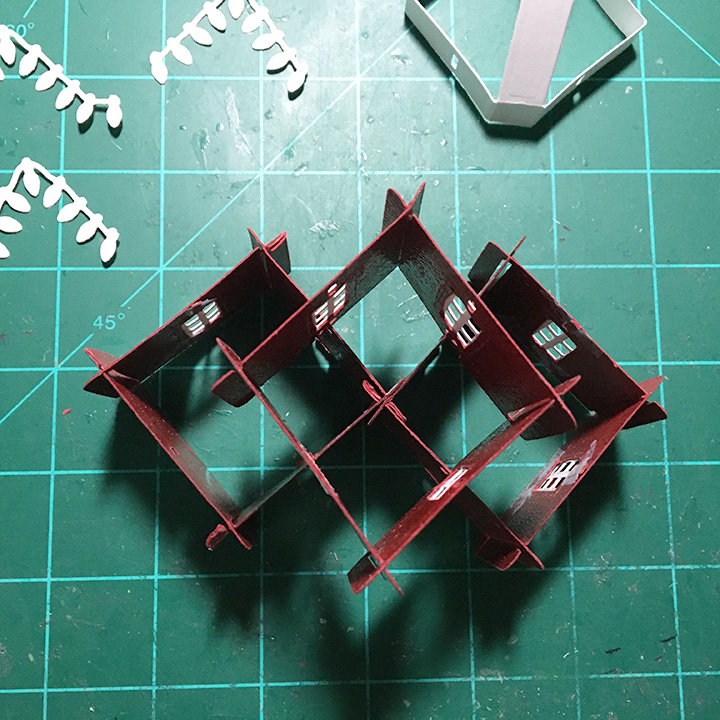
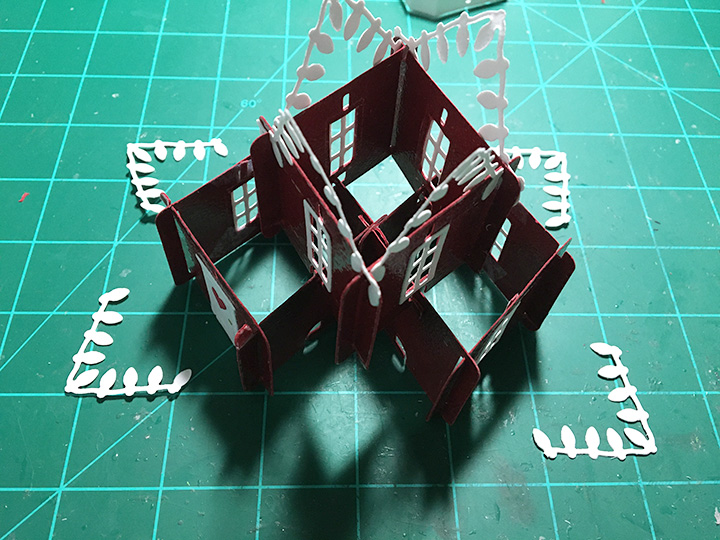
Vintage Christmas Cards – NO L Tree

Recently I came across some family Christmas cards I had designed with the help of my father who owned a letterpress printing press and had cuts (think metal stamps on wooden blocks similar to rubber stamps on wood blocks) made of my drawings. The printing press held an 8×10-inch galley or frame which held the cuts and metal type (letters). Paper was hand-fed into the press which had an electric motor connected with a leather belt which turned the press wheel. From about age 8 and on I earned pocket money running the press to add people’s names to their store-bought Christmas cards, “From the Desk of” notepads and other small print jobs from family and friends.

The five cards that I am sharing this week were created before the computer drawing program Auto-CAD was widely available to individuals. (I know we didn’t have access to digital type fonts that Apple computers offered around that time.) I used rulers, India ink pens and protractors to draw the pop-ups.

The NO L Tree card was a mash-up of another Christmas card my parents had done in the 1950s spelling out the alphabet but leaving a space where the “L” would have been, and a 3D triangle tree that I had made as a child which was made of two triangles cut with slits that allowed them to slide together. My father suggested having the sentiment in red ink be on two quadrants while the green alphabet be on the remaining two quadrants. We decided on different type fonts for the two sides.

Hand setting the type was a little challenging, but after several test runs, we found the proper placement. I think we created a cardboard template to trace the tree lines inside the card with a black pen.

Instructions on how to assemble the tree as well as the card title/subtitle and card credits were all made with hand-set type. To print one card, it took two runs of green ink, two runs of red ink and one run of black ink for a total of five runs and one hand tracing of the triangle lines. We would print 200+ cards each year and start printing in October.

My siblings and I think this card was made around 1980-1981.

Here are other vintage Christmas cards:

  • NO L Tree

Mother’s Day Keepsake Card

Recently I received a commission to make a Mother’s Day card that was to have all four of her children’s birthdays and names on it. The recipient likes gardening, traditionally receives flowers on Mother’s Day to plant in her garden and may soon be moving to a new home.

I began by looking through my paper stash and settled on a Graphic 45 paper collection that featured flowers of the months.  Karen Burniston’s Waterfall Card dies made it easy to create four different waterfall panels. It was the backgrounds panels for the card that were a bit more difficult since I had already cut into the papers for other projects. I ended up piecing together stripes of the flowers from the various months needed for the front of the card and a patchwork for the inside top panel. For the inside bottom panel that the waterfall rests on, I made stripes of the ribbon from the various flower papers. The card back is a whole piece of flowered cardstock.

Having reviewed the waterfall assembly video, I knew that a 5×7 (A7 size) card base with a top fold could accommodate the waterfall. For the hidden message of “love you,” I used the words from Karen Burniston’s Words Set 13 to die-cut into the decorative panel that goes to the pull strip. The background papers had all been adhered to the purchased card base when I die cut the finger semi-circle into the card base bottom panel. Having assembled the waterfall mechanism, I then stapled it onto the card base as shown in the assembly video.

For the customization of the names and birthdays, I used the postage stamp ephemera pieces from the paper collection for the month and then added the names and dates using Karen Burniston’s Mini Alphabet and Numbers die set.

Card Back

Ribbon can hide a multiple of small mistakes and liven up a card. On this card it softens the staples on the back of the card and brightens up the card front. The front sentiment is Karen Burniston’s “Happy Mother’s Day” which includes a shadow background die in the set. The white label inside can be used for a personal message and is cut using the largest of the fancy labels in the Crosshatch Rectangles and Labels die set.

The envelope uses more of the flowered paper for the back flap.

Materials Used:

Dies

Papers

  • Graphic 45 – 12×12 Double-Sided Paper – Flower Market Collection
  • DCWV – Textured Cardstock Stack 12×12 – Brights
  • Black Cardstock
  • Park Lane Paperie – A7 Card Base and Envelope – White

Pens

  • Pigma Micronn – Archival Ink – 01 Tip – Black
  • Sharpie – Permanent Marker -Ultra Fine Point – Black

Adhesives

Tools

Miscellaneous

  • Yellow Organza 3/4-Inch Wide Ribbon

Rainbow Flowers Birthday

April showers bring May flowers and this birthday card delivers on a rainbow of colorful wishes and flowers.

This pop-up twist and pivot card features dies by Karen Burniston and papers by Honey Bee Stamps. A white cardstock rectangle of 10 x 6 3/8-inches folded in half was used to create a 5 x 6 3/8- inches top-fold cardbase.

To create the twist and pivot panels, I first watched several assembly videos to understand how to combine the two mechanical mechanisms. (The flower and train pivot panels are similar and the directions for adding the pivot panels to the twist panel pop-up starts about two-thirds through in this assembly video. The assembly video for the Twist Panel Pop-up is here towards the bottom of the page.)

Pop-Up Panels: Because I was limited to using paper from a single 6×6-inch paper pad, I found that the largest die was the flower pivot panel which had to be cut diagonally from the square of double-sided paper. Once this was cut, all other pieces had to be cut based off the direction of the stripes. Two dotted 6×6 squares were joined together with clear removable tape on their backsides and die-cut using the X mechanism die from the twist panel pop-up set.  I used the excess strip of 1-inch cut from both the square dot panels to fill-in the holes where the mechanism folds up. Next, I glued the dotted panels into the card base with the clear tape joint going into the fold. The arms of the mechanism were die-cut from purple and glued to the X mechanism.

Flowers: There are dies in the flower pivot panel that can create three different large flower heads and one smaller flower. I created six of the white daisy, three of the yellow flower, three of the red flower, four of the purple flower and one small purple flower with leaves. I attached the two panels die-cut from the twist panel set to the flower pivot panel as shown in the assembly video. Decorating all the panels when they are flat is the easiest. Once decorated, attach panels as directed in the twist panel assembly video.

Decorations: The card front and back panels were covered with single sheets of patterned paper. The front features rain and clouds cut from the back of the double-sided paper while the back features a stained glass effect sunset. Grass edging was cut from the excess green strip cut from the back panel paper and used with the extra flowers to decorate the front and back of the card.

Sentiments: A large shadowed “Happy Birthday” was die cut from red and yellow to standout on the dark front. Stamped Funny Bones sentiments from Riley and Company grace the inside of the card and the envelope’s back flap.

Envelope: The tiny purple flower with leaves finishes the envelope flap. The card fits into an A7 envelope.

Thank you for reading this blog post. I hope this inspires you and makes you smile. Please like and leave comments 😊

Materials Used:

Dies

Stamps

  • Riley & Company – Funny Bones – A Year Older-RWD-1144
  • Riley & Company – Funny Bones – This Is An Annual Reminder -RWD-1142

Papers

  • Honey Bee Stamps -6×6 Double-Sided Cardstock Pad- Over the Rainbow
  • White cardstock 10 x 6 3/8-inches
  • A7 white Envelope

Ink

  • Simon Says Stamp – Premium Dye Ink – Slate

Adhesives

Tools

  • Die Cutting Machine
  • Stamping Platform
  • LDRS – Stampendable Stamping Tool
  • Stamping Cloth
  • Ruler
  • Scissors
  • Pencil